Real or AI? Take the quiz (and learn how to actually tell)
Bet you can’t spot the AI. Don’t feel bad — neither can the people who build this stuff for a living. Here’s the five-round quiz, plus the move the pros use instead of squinting.
By The Aipurity Team · July 15, 2026
Key takeaways
- In 2026, “real or AI?” as a looking contest is basically a coin flip — top models render hands, text and reflections cleanly, so your eyes are the wrong tool.
- The classic tells (fingers, warped text, odd reflections, waxy skin) still catch lazy fakes, but every one of them is fading with each model release.
- Pixel-only “% AI” detectors collapse on real-world images — a confident percentage with nothing to verify is a guess in a lab coat.
- The pro move is reading provenance — C2PA Content Credentials, Stable Diffusion PNG chunks, XMP “trainedAlgorithmicMedia”, EXIF — plus reverse image search, and saying “inconclusive” when a file’s been stripped.
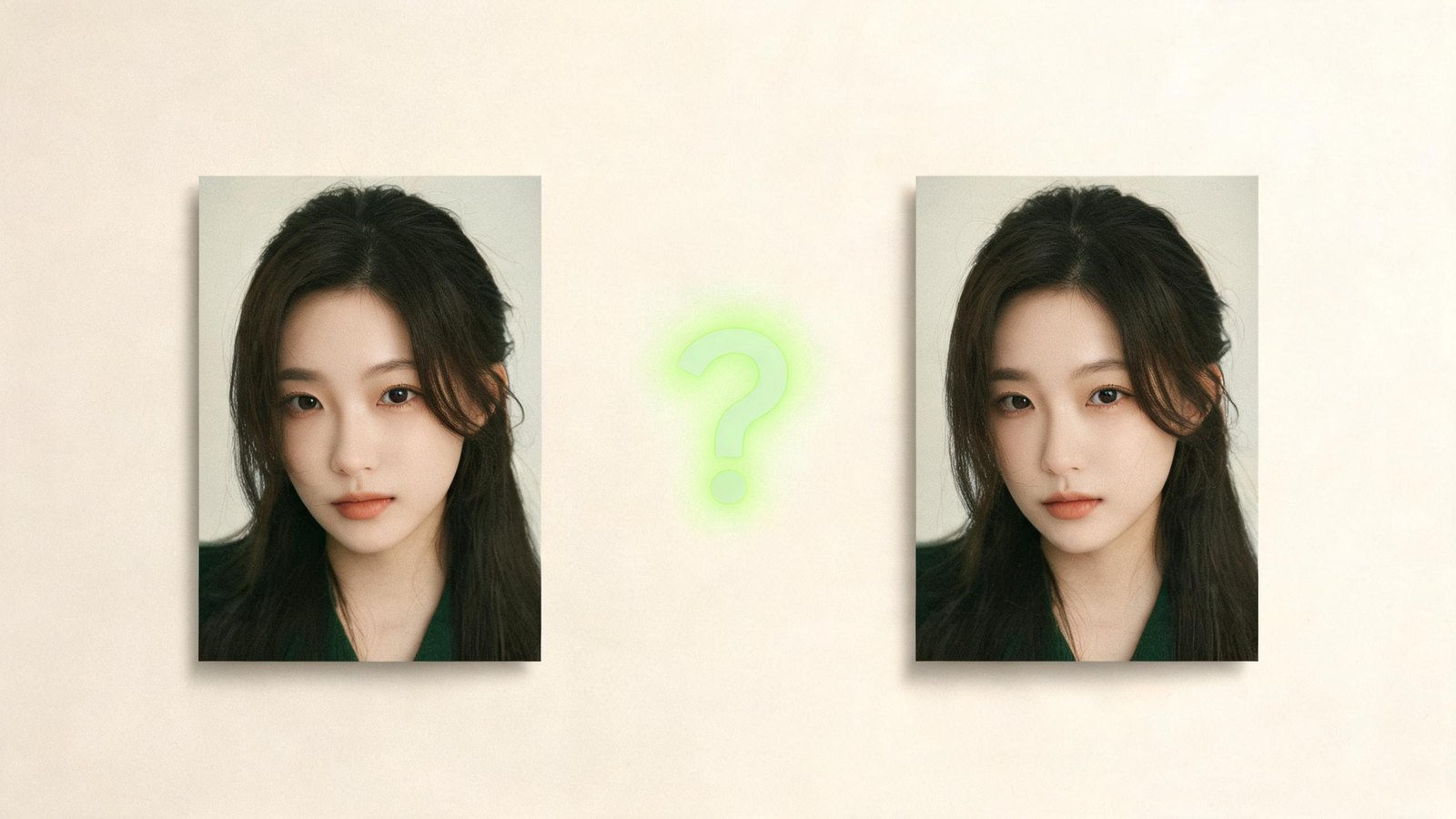
Think you can spot an AI image? Sure you can. So could everyone who just failed this. There’s a whole genre of “real or AI?” quizzes making the rounds right now, and they all end the same way: sharp, visually literate people scoring about the same as a coin toss and feeling personally attacked about it.
So before you scroll to the quiz — and there is one, five rounds, no images needed, just your gut — let’s put one uncomfortable truth on the table. In 2026, your eyes are not the tool for this job. Not because you’re bad at looking, but because the thing you’re looking at was built, quite literally, to beat your eyes.
Why this got so hard, so fast
Rewind to 2023 and catching an AI image was practically a party trick. Count the fingers — there’d be six. Read the sign in the background — it’d say something like “RSETAURANT”. Check the reflection in the sunglasses — it’d show a different dimension entirely. The tells were everywhere and smugness was free.
That era is gone. The current models — Midjourney, Firefly, the latest DALL·E and Imagen — render five-fingered hands, legible menus, and reflections that mostly behave. The glitches that used to blow the whole thing now turn up only in the cheap, the rushed, and the years-old. The good fakes glide straight past the exact checklist you were handed. That’s the trap: you’re running 2023 antivirus against a 2026 threat.
The classic tells (and why they keep letting you down)
You know the list. Everybody knows the list — that’s part of the problem. Here it is, with the footnote nobody prints on the infographic: the part where each trick quietly stops working.
- Hands and fingers — the original giveaway: six fingers, fused knuckles, a spare thumb. The catch: mostly fixed. Leading models now draw clean hands the vast majority of the time, so a normal-looking hand proves precisely nothing.
- Text and signage — warped gibberish on shopfronts, menus and book spines used to be an instant tell. The catch: fading fast. Short text often comes out flawless; only long paragraphs and dense type still trip the models up.
- Reflections and shadows — mirrors showing the wrong room, shadows pointing five ways, sunglasses reflecting nothing. The catch: this is one of the sturdier tells, since consistent light is genuinely hard to fake — but it improves every release too.
- Texture that’s too perfect — poreless skin, hyper-smooth gradients, that uncanny lack of sensor grain. The catch: it cuts both ways. Half your feed runs the same beauty filters, so “too smooth” flags real photos and waves fakes through in equal measure.
See the pattern? Every tell now comes with an asterisk, and the asterisks are winning. Any method built on “does it look off?” has an expiry date — and in 2026 the date is behind us.
Fine. The quiz. Real or AI?
Five rounds. No pictures — just vivid descriptions, which is honestly about all your brain has to go on in these quizzes anyway. Read each one, commit to an answer out loud (out loud — no weaselling), then hold your five guesses for the reveal. Ready?
- 01A slightly overexposed backyard barbecue. A kid has ketchup on one cheek, a garden hose is coiled in the grass, and someone in the background is caught mid-blink. Candid, imperfect, ordinary. Real or AI?
- 02A crisp LinkedIn headshot of a “startup founder”. Perfect catchlights in both eyes, poreless skin, a blazer without one stray thread. Looks like it cost money. Real or AI?
- 03A grainy protest photo: motion blur, a lens flare, and a hand-painted sign you can almost — but not quite — read. Urgent, newsy, a little chaotic. Real or AI?
- 04A latte with genuinely lovely foam art, shot straight down on a marble table, a couple of coffee-bean crumbs scattered just so. Café-perfect. Real or AI?
- 05A phone screenshot of a “friend’s” holiday snap — a beach at sunset, a single seagull, a horizon line that tilts a touch. Warm, casual, forwarded into your group chat. Real or AI?
Locked in all five? Good. Here’s the reveal: I’m not going to tell you the answers — and that refusal is the entire lesson. Every one of those scenes is produced, routinely and perfectly, by both cameras and models. The ketchup, the blink, the motion blur, the artfully scattered coffee beans, the wonky horizon — those “imperfections” are trivially easy to prompt for, and “candid messiness” ships as a preset now. Whatever you scored, you scored on vibes. And vibes, against a tool built specifically to beat vibes, round down to a coin flip.
The part that stings
It isn’t that you’re bad at this. It’s that “real or AI?” as a looking contest is unwinnable by design — the models train on billions of real photos precisely so their output tucks invisibly among them. Don’t feel bad — the models are literally trained to beat your gut. Change the tool you’re using instead.
How to actually tell (what the people who do this for a living do)
Here’s the aha you came for. The pros — fact-checkers, forensic analysts, trust-and-safety teams — quit squinting long ago. They swapped the losing question, “does this look fake?”, for a better one: “what can this file prove about where it came from?” That pivot, from guessing at pixels to reading evidence, is the whole trick — and you can do it too, free, in about thirty seconds.
Modern images carry receipts. Cameras, editors and AI tools increasingly write machine-readable records of what made a file and how it changed — and unlike pixels, those records don’t get better at lying as the models improve. The umbrella word is provenance, and four kinds do most of the work:
- C2PA Content Credentials — a cryptographically signed “nutrition label” baked into the file, naming who made it, with what tool, and how it was edited. Adobe Firefly, Photoshop, DALL·E and Google’s Imagen and Gemini attach it; Leica and Sony cameras sign real photos the same way. Signed means checkable — tamper with it and validation fails instead of lying to you.
- Stable Diffusion & ComfyUI PNG chunks — local, open-source generators stash their entire recipe in a PNG’s text chunks: the prompt, the model hash, the sampler, the seed. When those chunks survive, the image has effectively signed a confession.
- XMP “trainedAlgorithmicMedia” — a standard metadata field whose value is the industry’s official, machine-readable way of stamping “made by generative AI”. Firefly, Recraft, Leonardo and others write it. It’s a plain string: easy to read, hard to fake convincingly.
- The EXIF trail — the block a real camera leaves: lens, exposure, ISO, timestamp, sometimes GPS. A coherent trail gently supports a genuine capture. Its absence proves nothing by itself, though, because platforms strip EXIF from uploads as routine housekeeping.
And one move that isn’t metadata at all but wins constantly: reverse image search. Drop the picture into Google Lens or TinEye, sort by date, and hunt for the earliest copy. A “breaking news” photo whose oldest appearance is an AI-art forum from this morning has answered your question with zero forensics required. Context outlives pixels.
Enough theory — go read a real file’s evidence for yourself:Check a real image free →So does any of the old-school eyeballing still earn a place? A little — as a tie-breaker, never as proof. Here’s the honest 2026 scorecard:
| Classic tell | Does it still work in 2026? |
|---|---|
| Counting fingers, checking hands | Not reliably — top models draw clean hands; a normal one proves nothing |
| Reading background text and signs | Rarely — short text is often perfect now; only long, dense type still slips |
| Checking reflections and shadows | Sometimes — the sturdiest visual tell, but closing fast every release |
| “The skin looks too smooth” | No — beauty filters fake it on real photos; it cuts both ways |
| Reverse image search for the earliest source | Yes — still works, and gets stronger over time, not weaker |
| Reading C2PA and metadata provenance | Yes — the one method that improves as AI-marking becomes law |
Why “inconclusive” beats a confident percentage
One honest catch, and it’s the line between a real checker and a slot machine. Sometimes you read the evidence and find… none. The file was screenshotted, or squeezed through WhatsApp, or exported clean, and every receipt got stripped on the way. A truthful tool calls that “inconclusive” — not “91% real”. Absence of evidence isn’t evidence of absence: a stripped file might be a genuine holiday photo that shed its metadata in a group chat, or an AI image that was screenshotted precisely to bury where it came from.
Anything that launders that uncertainty into a confident number is inventing a figure it hasn’t earned. Peer-reviewed work shows why: the RAID benchmark watched “robust” pixel-only detectors slide toward a coin flip the instant they met a generator they weren’t trained on — gorgeous in the lab, a faceplant in the wild on the re-compressed, screenshotted images that actually circulate. So when a site flashes “87% AI” with nothing to click and verify, file it under decoration: a guess in a lab coat. A verifiable “inconclusive” beats an unverifiable percentage every time.
And the ground is tilting toward evidence anyway. From 2 August 2026, Article 50 of the EU AI Act requires providers of generative AI to mark their output in a machine-readable way, and anyone deploying a deepfake to disclose it. In plain terms: the share of AI images that show up carrying a readable receipt climbs every month, while pixel-guessing keeps sliding. Learning to read the marks isn’t just today’s smart move — it’s the one that gets stronger with age.
So… did you win?
Whatever you scored, here’s the reframe: the game was rigged, and the win was never going to come from staring harder. Next time your feed serves a “wait, is that real?” moment, don’t squint — trace where it came from, read what the file admits, and let the evidence decide, including the evidence that there isn’t any. That’s not surrender. It’s the exact move the pros make, and now it’s yours.
Go on — take the scenario that fooled you earlier, find a real file like it, and actually check it. Reading a receipt beats winning a guessing game, and it’s a whole lot harder to argue with.
Nailed the images? Video is the boss level — try one:Check a video too →Frequently asked questions
Can you really tell if an image is AI just by looking?+
Honestly, not reliably — not in 2026. Leading models now render hands, text and reflections cleanly, so “does it look fake?” scores about the same as a coin flip on modern fakes. The dependable move is to stop judging pixels and read the file’s provenance instead: C2PA Content Credentials, Stable Diffusion PNG chunks, an XMP “trainedAlgorithmicMedia” tag, or the EXIF trail.
What’s the best real-or-AI test?+
The best test isn’t a quiz — it’s reading evidence. Reverse-image-search for the earliest copy of the picture, then check the actual file for a signed C2PA manifest or generator metadata. A tool that shows you which bytes or which manifest it found beats any that hands you a bare percentage with nothing to verify.
Why do I keep failing these real-or-AI quizzes?+
Because the game is rigged against eyeballs by design. Image models train on billions of real photos precisely so their output blends in, and “candid” imperfections like motion blur or a wonky horizon are trivial to prompt. Failing doesn’t mean you have a bad eye; it means the eye is the wrong instrument.
Do the old tricks — counting fingers, checking text — still work?+
As tie-breakers, occasionally; as proof, no. Top models mostly draw correct hands and short text now, so a clean hand proves nothing and only obvious glitches mean anything. Reflections and shadows are the sturdiest visual tell, but they’re closing fast too. Treat visual tells as a hint, never a verdict.
Is there a free real-or-AI checker that actually works?+
Yes — use one that reads provenance rather than guessing at pixels, and that says “inconclusive” when a file has been stripped. Aipurity’s image and video checkers run in your browser, read the C2PA manifest and generator metadata a file carries, and show the evidence instead of a made-up confidence score. If a screenshot or re-upload erased the receipts, an honest tool tells you so.
Sources
Written by
The Aipurity Team
The Aipurity team builds free, provenance-first tools for telling real media from synthetic — reading the evidence a file actually carries instead of guessing at pixels. We write what we can prove, and say “inconclusive” when that’s the honest answer.